TABLE OF
CONTENTS
1.1 Executive Summary
1.2 Products &
Services
1.3 Target Customers
1.4 Competitive Positioning
1.5 Startup Options,
CAPEX & rationale (realistic 2025 estimates)
1.6 Example monthly
operating cost anchors (illustrative)
1.7 Break-even &
cash-flow (brief guidance)
1.8 Risks &
mitigations (high-level)
2.1 Industry Overview
2.2. Market Size & Demand Analysis (Focused on Lagos)
2.3 Market Opportunity for a Small Startup in Ojo
2.4. Competitive Landscape (Focused on Ojo Axis)
2.5. Pricing Strategy for Small Startup in Ojo
2.6. Customer Segmentation (Tailored to Ojo)
2.7. Demand Forecast for First 12 Months (Small Plant)
2.8. Market Entry Strategy for Ojo
2.9. SWOT Analysis (Small Startup in Ojo)
3.1. Production Process Flow (Step-by-Step)
3.2. Required Equipment for Small Plant (2025 Prices in ₦)
3.3. Raw Materials Needed
3.4. Floor Space & Factory Layout
3.5. Workforce Structure & Salaries (Small Plant)
3.6. Operational Expenses (OPEX) Model per Month
3.7. Production Capacity & Output Estimates
3.8. Revenue Projection (Small Plant)
3.9. Estimated Gross Profit
3.10. CAPEX Summary for Small Plant in Ojo
3.11. Power Requirements
3.12. Implementation Timeline
4.0 Organizational Structure
4.1 Management Structure
4.2 Staff Roles and Responsibilities
4.3 Marketing Strategy
4.3.1 Target Market
4.3.2 Unique Selling Propositions (USPs)
4.3.3 Marketing Channels & Strategies
4.4 Implementation Timeline (First 6 Months)
5.0 Financial Plan
5.1 Start-Up Capital Requirements (Estimated)
5.1.1 Capital Expenditure (CAPEX)
5.1.2 Working Capital (First 3 Months)
5.2 Projected Monthly Operating Expenses
5.3 Revenue Projections
5.4 Annual Revenue And Profit Forecast (5 Years)
5.5 Break-Even Analysis
5.6 Cashflow Projection (Year 1 Summary)
5.7 Return On Investment (Roi)
5.8 Sustainability Strategy
5.9 Risk Analysis & Mitigation
6.0 Appendices
6.1 Appendix A – Sample Carton Types & Specifications
6.2 Appendix B – Sample Product Catalogue (Text Version)
6.3 Appendix C – Raw Material Specifications
6.4 Sample Packaging Design Descriptions
6.5 Operational Policies
6.5.1 Production Policy
6.5.2 Health, Safety & Environment (HSE) Policy
6.5.3 Inventory & Store Policy
6.5.4 Quality Assurance Policy
6.6 Document Templates
Template 1: Customer Quotation Format
Template 2: Delivery Note
Template 3: Daily Production Log Sheet
Template 4: Invoice
Template 5: Staff Attendance Sheet
1.1 — Executive Summary
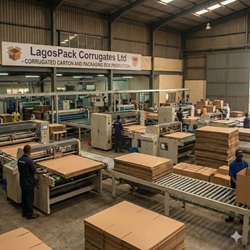
Business name (suggested): LagosPack Corrugates Ltd.
Location: Industrial area, Ikeja / Oba Akran / Apapa corridor,
Lagos State (proximity to ports & manufacturers).
Business: Manufacture and supply corrugated cartons, die-cut
boxes, printed retail boxes, partitions, and protective packaging for FMCG,
food processors, e-commerce sellers, and exporters.
Capacity (example): Small plant: ~3,000–6,000 standard
boxes/day; Medium plant (semi-automated): ~20,000+ boxes/day (final capacity
depends on machine line selection).
Legal form: Private Limited Company (recommended) — easy to
scale, limited liability.
Why it’s viable: Nigeria’s corrugated boxes market is growing
strongly (high CAGR and rising local demand from manufacturing, e-commerce and
FMCG). The overall packaging market in Nigeria is estimated ~USD 0.92B in 2025
and corrugated demand has shown double-digit growth historically, indicating
strong demand for local producers.
1.2 — Products & Services
· Single-/double-wall corrugated cartons (standard shipping
boxes).
· Die-cut retail boxes (printed/laminated) for branded FMCG.
· Partitions, trays, and pads (protective inserts).
· Special printed cartons (flexo printing for brand owners).
· Value-added services: die-cutting, printing, custom sizing, JIT
deliveries to manufacturers, and export packaging.
1.3 — Target Customers
· FMCG manufacturers (food, beverages, detergents).
· E-commerce fulfilment companies & marketplaces.
· Beverage bottlers and agro-producers (yams, fruit exporters).
· Electronics/white goods assemblers (secondary packaging).
· Trade/wholesale distributors and logistic companies.
1.4 — Competitive Positioning
· Fast turnaround, custom sizing, local presence near ports
(cheaper lead times vs imports).
· Focus on quality (double-wall strength for exports), competitive
pricing and flexible minimum runs (small businesses often can’t meet big
minimums from larger factories).
· Offer design & printing bundled services (value-add).
1.5 — Startup Options, CAPEX &
rationale (realistic 2025 estimates)
I present two practical startup scenarios — Small
(simple/semi-manual) and Medium (semi-automated).
Prices shown reference recent market listings and Nigerian price indicators; I
convert USD→NGN at ₦1,450 / USD (approx NFEM / market levels
in Nov 2025).
Key cost anchors used
· Corrugated paper / kraft paper import price (CIF) ≈ $1,179
/ ton (reference import price trend).
· Die-cut / folder-gluer machine lines: $13,000–$160,000+
depending on manual/automatic and speed; cutter-folder-gluer lines can be
$30k–$160k on supplier marketplaces.
· Warehouse/industrial rent — Ikeja / Lagos listings show wide
range; average warehouse rent examples ~₦18,000,000/year in
Ikeja with specific listings varying by sqm. Use locally-checked quotes when
finalising.
Small Plant (Entry-level / Semi-manual) — Suggested CAPEX (illustrative)
· Basic machines (used/new small lines: die
cutter, folder-gluer, slitter/score equipment, hand tools): USD
13,000–40,000 → ₦18.9M–₦58.0M.
· Initial raw material stock (kraft/corrugated
paper): assume 5 tons @ $1,179/ton = $5,895 →
₦8.55M.
· Factory fit-out, power backup (generator), utilities
connection, small forklift, tooling & dies: ₦6M–₦12M.
· Working capital (3 months): payroll, power,
transport, consumables: ₦4M–₦8M.
· Legal, licensing, first-year insurance, branding &
small office: ₦1.5M.
Estimated small-plant CAPEX + initial working capital (total):
₦40M – ₦60M (rounded range).
Medium Plant (Semi-automated, commercial line) — Suggested CAPEX
(illustrative)
· Automated/fast line equipment (flexo printer +
slotter + die-cutter folder-gluer line + slitter-scorer + upstream corrugator
if fully integrated): USD 60,000–200,000+ → ₦87M –
₦290M (machine selection defines cost).
· Initial raw material stock (10 tons): ≈ $11,790
→ ₦17.1M.
· Factory fit-out, 3-phase power upgrades, medium forklift,
fork truck, storage racking: ₦20M–₦40M.
· Working capital (3–6 months): ₦25M–₦60M.
· Vehicles (small truck), licensing, printing plates,
initial marketing: ₦5M–₦12M.
Estimated medium-plant CAPEX + working capital (total): ₦120M
– ₦300M+ (rounded range).
Note: machinery prices have a wide spread (simple folder-gluer sets can be
as low as ~$13k, full high-speed flexo+die lines go well past $100k). Choose
equipment to match your desired capacity and product mix (printed retail boxes
cost more to produce).
1.6 — Example monthly operating cost
anchors (illustrative)
· Rent (factory 400–1,000 sqm): highly variable.
Recent Ikeja listings average around ₦18M/year but smaller or
premium locations differ; pencilled monthly rent ₦1.0M–₦3.0M
depending on size & location. Use actual site quotes to finalise.
· Electricity (Industrial band A/C): tariff bands
around ₦48–₦209 / kWh depending on service band; many
industrial consumers budget for bulk power + generator fuel (for backup).
Expect electricity and fuel to be a major recurring cost—factor ₦300k–₦2M+/month
depending on production hours.
· Payroll: minimum wage is ₦70,000/month
(statutory baseline), but skilled machine operators, supervisors and admin
staff will command higher pay; approximate monthly payroll for small plant ₦800k–₦2.5M
(depending staff mix).
· Raw material (monthly replenishment): variable
by run — budget ₦3M–₦15M depending on order book and output.
1.7 — Break-even & cash-flow
(brief guidance)
· Focus on securing anchor contracts with FMCG or
e-commerce clients (minimum monthly tonnage) to cover fixed costs.
· Typical gross margins in corrugated box manufacturing vary by
product complexity — plain shipping boxes: lower margin; printed retail boxes:
higher margin. Aim to price to cover variable costs (paper + glue + labor +
power) and to recover fixed costs within 12–24 months depending on CAPEX size
and sales ramp.
1.8 Risks & mitigations (high-level)
· Raw material price volatility (import-dependent
kraft paper) → mitigate with supplier contracts, local sourcing blends, and
staggered purchases.
· Power supply & fuel costs → invest in
efficient genset, consider hybrid solutions, manage production schedules to
low-cost windows.
· FX exposure for imported machines & raw
materials → price in ₦ or hedge, keep a cash buffer. Use local suppliers where
possible.
2.1 Industry Overview
Nigeria’s packaging and corrugated carton industry has grown steadily over
the last decade due to rising manufacturing output, increasing retail product
packaging, and the rapid expansion of e-commerce. Lagos accounts for over
45% of Nigeria’s formal manufacturing capacity, making it the
highest-demand location for packaging materials.
Key drivers:
· Growth in FMCG companies around Lagos (Ojo,
Apapa, Ikeja, Surulere, Ojota, Oregun).
· Expansion of e-commerce and logistics operators
(Jumia, Konga, small online stores).
· Increased export activity from traders dealing
in agricultural products requiring sturdy corrugated packaging.
· Shift from low-grade packaging to stronger branded carts
for premium foods, electronics & cosmetics.
· Government restrictions on single-use plastics
driving companies to use paper-based packaging alternatives.
For a small startup in Ojo, these drivers are especially valuable because
Ojo is close to Alaba International Market, Trade Fair
Complex, Volks bus-stop industrial clusters, and Alaba
Rago agro-exporters, creating a highly diverse customer base.
2.2. Market Size & Demand Analysis
Lagos consumes an estimated 55,000–75,000 tons of corrugated boxes
per year, assuming:
· High FMCG concentration
· Transport packaging demand for wholesalers
· E-commerce surge
· Export packaging for seafood, fruits, dry goods
Demand is strong across these segments:
i. FMCG Manufacturers (40–50% of total demand)
These include manufacturers of:
· Seasonings & noodles
· Confectioneries
· Detergents
· Beverages
· Bottled water
They use corrugated cartons for secondary packaging, meaning continuous demand
every month.
ii. E-Commerce and Logistics (15–20%)
This sector exploded in the last 5 years. These buyers need:
· Mailing boxes
· Branded shipping boxes
· Small packaging boxes for gadgets, phones, fashion items
This segment is lucrative because they prefer smaller order quantities — which
small factories can supply quickly.
iii. Wholesalers, Market Traders & Distributors (20–25%)
Located within Ojo, Alaba, Trade Fair, Orile, Mile 2,
wholesaler markets frequently purchase cartons in bulk for:
· Electronics
· Shoes
· Phones & accessories
· Household items
iv. Agro processors & exporters (10–15%)
These include exporters of:
· Smoked fish
· Dried foods
· Fruits
· Packaging for cross-border trade (Seme route, Badagry)
These buyers often require double-wall boxes, which your
plant can produce.
2.3 Market Opportunity for a Small Startup in Ojo
A small plant (semi-manual) is well-positioned because Ojo offers:
A. Proximity to high-demand commercial clusters
· Alaba International Market — electronics,
gadgets, accessories (high carton demand).
· Trade Fair Complex — traders dealing in everything
from cosmetics to provisions.
· Iba, Okokomaiko & Festac small manufacturers
— many require cartons in small batches.
· Orile Industrial Area — manufacturing clusters
accessible by road.
B. Ease of distribution
Ojo connects to:
· Badagry Expressway
· Mile 2 (central distribution corridor)
· Apapa/Tin Can ports (import-export routes)
This reduces delivery cost significantly.
C. Low-to-medium competition
Big carton producers (e.g., in Ikeja or Oregun) rarely serve small clients
or low-volume custom orders because:
· They prefer large, continuous orders
· Their MOQs (minimum order quantities) are often high
· Lead times can be lengthy
Your small plant can:
· Offer lower MOQs
· Deliver faster (3–7 days)
· Produce custom sizes for small traders
· Sell unbranded plain cartons at competitive rates
This fills a gap in the Lagos market.
2.4. Competitive Landscape
There are three categories of competitors:
i. Large-scale manufacturers
These include established corrugated box factories with automated lines.
Strengths: Low unit cost, high speed, big clients.
Weaknesses: Long lead times, avoid small clients, high MOQ
(5,000–10,000 units).
ii. Medium-sized converters
These produce limited varieties with flexo printing.
Strengths: Slightly flexible.
Weaknesses: Still focus on medium clients; usually won’t take
orders below 1,000 units.
iii. Small semi-manual operators
These are your closest competitors.
Strengths: Competitive pricing, small runs.
Weaknesses: Poor finishing, inconsistent quality, low printing
capability.
Your major competitive edge:
You can combined:
· Standard quality corrugated strength
· Custom production
· Small or large batch flexibility
· Fast delivery
· Better finishing and quality control
This will immediately lift you above typical small Ojo-area competitors.
2.5. Pricing Strategy for Small
Startup in Ojo
Because you will operate a semi-manual setup, your pricing must reflect:
· Material cost (kraft paper)
· Labour
· Glue/ink
· Power (Lagos power + generator backup)
· Transport & delivery
Typical Lagos carton pricing ranges (2025 realistic market pricing):
A. Standard Shipping Boxes
|
Size
|
Avg Selling Price (₦) per unit
|
|
Small carton
|
₦250 – ₦400
|
|
Medium carton
|
₦450 – ₦700
|
|
Large carton
|
₦800 – ₦1,500
|
|
Export double-wall carton
|
₦1,300 – ₦1,800
|
B. Die-Cut/Printed Retail Boxes
|
Type
|
Avg Selling Price (₦) per unit
|
|
Small product box
|
₦150 – ₦350
|
|
Cosmetic/Phone box
|
₦200 – ₦450
|
|
Premium printed retail box
|
₦500 – ₦900
|
Minimum Order Quantities (recommended)
· Plain cartons: 100–300 units
· Printed cartons: 500 units minimum
· Export double-wall: 50–100 units
This makes your business attractive to SMEs, market traders, exporters and
e-commerce sellers.
2.6. Customer Segmentation
Primary target customers
1. Electronics merchants at Alaba International
2. E-commerce sellers in Festac, Iba, Okota, Trade Fair
3. Distributors in Mile 2 & Suru-Alaba axis
4. Food processors around Iyana-Iba, Okokomaiko
5. Agro exporters using Badagry corridor
Secondary customers
· Printing presses
· Gift-box makers
· Schools
· Hospitals
· Logistic companies
· Packaging wholesalers
Each of these segments provides continuous patronage.
2.7. Demand Forecast for First 12
Months (Small Plant)
A small plant in Ojo can realistically produce 3,000 – 6,000 cartons
per day depending on size and labor strength.
A conservative but achievable 12-month forecast:
Month 1–3 (Entry Phase)
· 1,000–2,000 cartons/day
· Focus on small clients and traders
Monthly revenue target: ₦1.2M–₦3.5M
Month 4–8 (Growth Phase)
· 2,500–4,000 cartons/day
· Secure 2–3 stable FMCG/wholesale customers
Monthly revenue target: ₦4M–₦7.5M
Month 9–12 (Stabilization Phase)
· 4,000–6,000 cartons/day
· Contract orders + standing weekly orders
Monthly revenue target: ₦8M–₦15M
2.8. Market Entry Strategy for Ojo
Your entry strategy should include:
A. Fast penetration to Alaba & Trade Fair markets
· Provide catalogue of sizes
· Offer wholesale discounts
· Provide 24–48 hour production for plain cartons
· Give free sample cartons to major electronics traders
B. Digital presence
· Facebook & Instagram ads targeting:
o
Festac
o
Iyana-Iba
o
Okokomaiko
o
Mile 2
o
Surulere
· Offer small MOQ (100 boxes) for online sellers
C. Strategic partnerships
· Logistics companies
· Local printers
· Manufacturers needing continuous supply
· Export agents around Seme/Badagry
D. Pricing advantage
Because you have lower overhead than Ikeja factories, you can:
· Undercut competitors by 10–20%
· Offer discounts on repeat orders
· Provide credit terms for trusted customers
2.9. SWOT Analysis
Strengths
· Low startup cost
· Flexible MOQ
· Strong local demand
· Proximity to key markets
· Fast production & delivery
Weaknesses
· Limited printing quality (semi-manual setup)
· Dependence on imported kraft paper
· Power supply constraints
Opportunities
· Growing e-commerce packaging demand
· Export packaging demand rising
· SMEs prefer small flexible suppliers
· Ojo/Trade Fair market proximity
Threats
· FX fluctuations affecting raw material prices
· Competition from medium-sized factories
· High diesel/electricity cost
· Price-sensitive customers
Click “DOWNLOAD NOW” below to get the complete Business Plan
FOR QUICK HELP CHAT WITH US NOW!
+(234) 0814 780 1594



Login To Comment